
Early Lives – Erika
Erika left school when she was fourteen, at
about the time that the Second World War broke out. Until then, she wasn’t
really aware of the approach of war, but things soon changed. For a year she
had to work as a sort of ‘home help’ in a household. This was compulsory for
girls when they left school (boys had to work on the land for a year when they
left school). She went to the central registry and was assigned to a house. The
place where Erika worked was in the town, so she could return home at night.
The work was difficult and tedious, as it involved doing all the housework. The
person she worked for was not very nice. She was only fourteen at the time, and
received a pittance of about five Reichsmark per month.
After a year, Erika started to work in a
factory in the town. It manufactured light bulbs and employed many
people. The factory was a part of a complex which produced armaments. In the
war, they continued the production of light bulbs but other parts of the
complex were involved in secret war work. She earned about twenty Marks per week
and got on well with the other girls. They often had sing-songs during which
they would “sing their hearts out!” They also had social evenings.


Early Lives – Günter
 |
Günter |
Günter and Erika met for the first time on
the street. He had a pair of shoes under his arm, and he stopped her to ask for
directions to the shoemaker. In fact, he was right in front of the shoemaker,
but he didn’t realize this, being a stranger in the town. Erika’s first
impression was that he was a “nice boy!” That was during the summer of 1943.
They didn’t meet again until the Christmas
party in the factory, and they were engaged to be married soon afterwards.
Their marriage took place in Fürstenwalde (photos of the church) in February
1944. It was a simple affair, as would be expected during such difficult times.
Günter was home on leave at the time. After returning to his duties, he had
another period on leave before being posted to Italy. The couple had a son born
in December 1944 whom they named Bernd.
 |
| Marriage of Erika and Günter |
Wartime Fürstenwalde
The war was very real for the inhabitants
of Fürstenwalde. There was an air-raid on the wedding day of Günter and Erika.
They were forced to spend their wedding night in the air-raid shelter. There
were many bombing raids, as it was a prime target area due to the proximity of
an airfield. Erika’s family had their own shelter in the yard, and they often
spent entire days within it. It was very difficult, but at least they got away
with their lives and their house was not damaged by bombs.
In 1945, the entire town was bombed out and
many people were killed. A few doors away from Erika, there was a woman with
ten children who all perished in one night. Erika could never forget that poor
woman. The next day, they went to see the ruins – they probably should not have
done so but curiosity got the better of them. There was a three month old baby
who was never found.
Günter’s mother lived alone in Berlin. She
was bombed out on three occasions. Her house was destroyed, so she arrived on
Erika’s doorstep in Fürstenwalde. “Please, let me in, I have nowhere to go to!”
She stayed for a few days before going to stay with her daughter.
 |
| Fürstenwalde toward the end of World War II |
One-Man Submarines
Günter was involved with secret war work,
designing one-man, or ‘midget’ submarines. These submarines were about 14 feet
(?) long and were intended to perform the same sort of functions as
conventional submarines, but under the control of one man. Once they were
designed and built, they were brought to Italy. They were transported by
articulated lorries over the Brenner Pass in winter – a difficult journey.
Günter was initially in Venice, and was
then moved to Trieste before December 1944. He worked to perfect the
submarines. They worked well, but had nothing to shoot at! The war was well
advanced by that stage, and the allied invasion of France and Italy had begun.

Prisoner in Belgrade
The Americans took Günter in Trieste. The Americans did not care much about them,
and handed thousands of them over to the Russian army, who in turn gave them to
Josip Tito, who was emerging as the leader of post-war Yugoslavia.
Günter and his fellow prisoners were forced
to march to Belgrade, a distance of 330 miles. They had to march a fixed
distance per day, and those who could not were simply shot. Many died on the
way. Before they left Trieste, many of Günter’s comrades stole from wagons and
stores – they had two pairs of shoes, two uniforms, and were so packed with
provisions that they could barely move! Günter packed his rucksacks full of
cigarettes and butter, taken from the wagons, which he planned to use to
bargain with. The march took months. Many of their guards, Yugoslav partisans,
had bare feet. “They were a bunch of undisciplined layabouts, but they had the
guns so they were right!”
When they reached Belgrade, they were put
into camps and segregated by their proficiency in various fields. The Yugoslavs
were looking for specialists, and as Günter said, “The war is finished, we have
lost now, I may as well do the best I can, I could do with a good job!”
Accordingly he volunteered. He was still in good health despite the march.
Günter worked in a factory making central
heating units. He was skilled in electrical welding, and he showed them a few
things, as they did not have the faintest idea. Günter overcame his POW status
to become the foreman, in charge of the Yugoslav workers, most of whom were
Macedonian (?). The factory made flanges and big pipes. When the items were
tested successfully, they received extra rations.
Günter was in a separate group of about
twelve prisoners of war, who lived in an old house in a factory yard. The
prisoners fixed up the house so that they had bunks, central heating and a
shower. Most of the educated Yugoslavs spoke German, so there was no problem
communicating. They treated Günter reasonably well, but he knew of men who were
beaten half to death because they were obstinate or argued back. Günter said to
himself that he hated pain, so he co-operated!
Günter remained in Belgrade until November
1948, when he was released. Four of his fellow prisoners had to remain. The
director of the factory who stayed, and who was freed, depending on who was
needed. “If you filled your quota, you were free!” He returned home with
honours, and a recommendation from the factory that he was a good worker, and
he could go back at any time.
Russian Zone
Conditions in the factory at Belgrade were
luxurious compared to those in Fürstenwalde. At the end of the war the bombing
stopped, but conditions deteriorated when the Russians took over. There was very little food; certain items
were rationed while many things were simply not available. They had to beg,
borrow and steal to survive. The Russians were in control of everything,
including jobs and food, and treated the local people very badly. The streets
were renamed after Lenin and Stalin and the children had to learn Russian in
school. It was like a Russian colony.
Erika did not know where Günter was for a
year after the war ended. She heard nothing until a card arrived through the
Red Cross that he was alive and well. It was a relief after a year and half of
not knowing. After that Erika sent a card and they could write to each other.
Erika was still living with her parents.
They could get half a pint of milk a day for the baby and a couple of spoonfuls
of sugar. Everyone clubbed together to save all rations for the child. The baby
had dysentery and typhoid. He is very lucky to be alive today as he was
practically dying for the want of food.
This went on until 1948 when Günter came
home. He decided they would leave Germany the first chance they got as he could
see there was no future there and he would not work with the Russians.
Travelling was very restricted and everyone had to show their passport.
Günter came home to Germany in November
1948 and in the new year he got a job in a factory making conveyor belts.[2] The
factory worker was a learned man and was fond of Günter. He was a German and
had built the factory up from scratch. He did not want to work for the Russians
either and began a plan to escape.
“See Wolf”
In the north of Germany on the Baltic coast is the island of Rügen. The town of Stralsund is nearby. The factory owner, Walter Kuneth, asked Günter to go to Rügen to work on rebuilding a 54’ yacht. Only the hull was in existence as the yacht had sunk during the war off the northernmost tip of the island. They didn’t know (or ask) who the hull belonged to, but it had been a luxury yacht before the war and had won a race from Germany to Australia. They renamed it See Wolf.
 |
| See Wolf |
Günter was the main person working on rebuilding as he had naval experience. He was helped by men from the factory that went up a few times a week. The hull was towed to the village of Seedorf and rebuilt so that when completed it had 8 berths with a further two in the wheelhouse.
Erika and Bernd moved up to Stralsund while
Günter was working on the boat. They stayed for a while on a barge and in
lodgings. When the boat was finished they lived on board. They were there for a
good while.
 |
| Cabin of the See Wolf |
In 1950, Erika was pregnant with Marion and when the baby was due Günter sent her and Bernd home to Fürstenwalde. The plan was that she would have the child there with her parents and return to Stralsund afterwards. The day after Marion was born, Erika’s mother sent a telegram to Günter but it came back marked ‘address unknown’. They were flabbergasted; they did not know where he had gone. Then they read about it in the papers that Walter Kuneth, his 2 sons (aged about 6 and 8) and Günter had escaped to West Germany. Erika knew nothing about it and had to read about it in the papers.
Escape to West Germany
When Erika was having Marion in
Fürstenwalde, the situation had deteriorated rapidly in Stralsund. The postman
came with a telegram for Walter Kuneth and the woman in the local pub phoned
him and told him that people were coming to look for them. The secret police
had been suspicious of them as they had been doing things to fix the boat which
were not “quite kosher”. As soon as he heard that they were being sought,
Walter said to start the engine as they would go. On board were his two young
sons Peter and Garth (?) and Günter. They started up and went along the coast
towards the Kiel Canal. They were pursued and shot at but were not stopped.
Once they reached the Kiel Canal they were safe as that was in West Germany.
They then went to Bremerhaven.
Meanwhile, Erika and her two children and
the skipper’s wife and daughter were all left behind. Erika was again left
alone! Günter sent her a secret letter through friends telling her to sell
everything and come. Erika did not know what to do at first. They had their own
flat by then. She sent bedding, blankets etc in parcels to Günter in
Bremerhaven. The postman might have gotten suspicious but at that time parcels
of bedding was not uncommon after the war. The authorities were not watching at
that time, but everything had to be kept secret.
Günter had given Erika a friend’s address
in West Berlin as a base for her to organise her escape. It took a lot of time and planning but Günter
had left money behind so she could live for the few months. Erika sent parcels
of possessions to Günter and also sold some clothes and other goods. She went
to Berlin and registered there in the American sector. She had to make regular
visits to West Berlin. Every day, early in the morning, she left the children
with her parents and went to Berlin on the first train. In West Berlin she got
her papers in order, arranged for a West German passport and sorted out various
details. She visited the British and American embassies. Everything was left
there and not brought back to the east. There were thousands of people wanting
to get out. It was easy enough to in and out of West Berlin, but everyone was
searched and questioned a lot. She would say she was going to West Berlin to
get food as they had everything there, including things like bananas and
oranges.
Eventually everything was ready in April
(?) 1951. Her parents brought her and the two children to the airport in Berlin
and she flew to Hamburg. It was the first time she had been on an aeroplane.
The stewardess came straight away and took Marion to where she would be
comfortable and she got a nice seat by the window.
The flight took about an hour. She felt
lonely leaving her parents behind. Her father was crying at the time,
particularly as they did not want Bernd to go. Erika kept in touch with her
parents until they died.
In Hamburg Günter was waiting for her. She
didn’t know whether to scold him or be glad! They were safe now, nobody could
touch them.
Bremerhaven
From Hamburg the family went by train to
Bremerhaven and lived on the See Wolf “like gypsies”. There were 15 of them on
board. Kuneth’s wife and daughter Rosemary had joined them and in addition
there were other adults.
The plan was to go to Uruguay in South
America where many Germans had settled after the war. The problem was that
money was needed for the journey and to establish themselves there. So it was
decided to sail there with See Wolf, using combined resources of the various
families and individuals. One girl, Anna, did not pay but in return was to cook
and clean etc for the others.
It was hard to live on See Wolf. Erika
wouldn’t do it again as it was too crowded and peope got on each other’s
nerves. They lived there for about a month after Erika arrived. They got ready
for the journey, enjoying the freedom to sail where ever they chose and to make
open preparations.
Most of the people on board were German who
were going to leave Germany anyway. Kuneth had advertised in the paper for
passengers, particularly for master tailors with their own sewing machines as
he planned to set up a factory in South America. There were 5 master tailors
and they all wanted to leave and all paid. There were 15 people in total, 5
children and 10 adults.
To sea in a “Nutshell”
One fine morning in May 1951, they left
Germany for good. Erika said “I will never forget it. I was standing on board
waving goodbye to Germany”. They planned to call to Dover, Cherbourg and
Falmouth before heading south to Spain and then across the Atlantic. Erika does
not think they would have ever made it as it would have taken 3 or 4 months and
water and food would have been a problem. “See Wolf was like a little
Nutshell”.
Günter was the only person on board who
could read a compass or a navigation chart. Early on everybody, including the
Skipper, was seasick – only Günter was able to sail the boat. Erika was very
seasick as she had never sailed before.
Dover was their first stop for fresh water
and food, but they were not allowed to land as feelings there were hostile to
Germans. They were barley allowed get food and water for the baby who was 4
months old by then. They did not stay long.
From Dover they went to Cherbourg where
they had a great time and took on more food and water. They people were very
friendly. Before they reached Cherbourg they had sailed half way up the Seine
to Paris because of a navigational error!
Falmouth was the next port of call – by
then Erika had had enough! They were welcomed there and the mayor gave them a
civic reception. See Wolf was lying beside big ships and the crews invited them
to take showers as they had no showers on board. They stayed there for a few
weeks because the weather was atrocious in the Bay of Biscay.
When they heard that the weather was good,
they set off to Vigo. They were in the middle of the Bay of Biscay when a huge
storm came up. They were terrified. They lost their sails, the dinghy, all the
charts and the engine broke down. Everything went wrong. The water came up in
the bunks and Erika thought that they were going to drown. The loss of the
charts meant that they were sailing “blind”. Erika thought it was the end. Günter
calculated on a school atlas belonging to one of the children that their only
hope was Ireland. So they drifted north.
 |
Günter |
Ballycotton
The engine was broken so they just drifted
along. Nearly everyone was seasick including Erika who was very ill and could
barely look after Marion who had not been washed for weeks. They were very
short in food and water.
They drifted up and could see Ireland
faintly in the distance. Günter reckoned that they should arrive at Cork – this
was good reckoning as they were in fact just off Ballycotton. They were
wondering how they were going to make it in when up came the old Innisfallen
going to Swansea. They were delighted to see her and raised a flag asking for
help. The Innisfallen came over and with a loud speaker they asked what was the
matter. They said they were very glad to see her and asked them to organise
someone to pull them into harbour. Erika was so glad to see land! Everyone was
relieved.
Crowds gathered to watch them arrive. The
local people were swarming all over the place. The press were also there and
the photographs were taken of them all. The main attraction was Marion –
everyone wanted to see the East German baby! Erika put her on the pier and took
a photo of her. Later, Marion was out in the pram in the road and people kept
throwing money into her pram!
At Ballycotton they had to seek permission
to wash their clothes. They washed and washed and hung the clothes over the
pier – Erika wished she had taken a photo of it! It was a sight with the whole
pier full of clothes! People invite them into their homes and the house on the
corner (pub) invited them in and gave them a party. Local people were very good
to them and brought them eggs, milk for the baby etc. The Red Cross came and
brought them food too. They could not eat it all they had so much!
The priest came down and the bells were
ringing so he invited them to go to church. They did not know that Ireland was
a Roman Catholic country; in fact they knew nothing about Ireland. They went to
church on Sunday, although they were mostly Lutherans.
Only one of the group, Hans, spoke English.
He came from south of Germany, was a pilot during the war and had been a POW in
America so he spoke good English. He did all the interpreting. He was a master
tailor and made suits for everybody. Mr. Connolly of Ballycotton still had the
suit up to a few years ago! Hans later went to America and is now dead.
The group stayed in Ballycotton for about a
month and applied for asylum and within three days they had it. Günter and
Erika decided to stay – Erika refused to go any further! The others did not
want to stay permanently in Ireland. They were impressed by the Gardaí. The
Garda who came to see them was very casual, didn’t want to know any details and
said that they should receive asylum without any problem. He also brought Günter his first pint of
stout! No policeman would do that in Germany!
Günter had his first job in the harbour;
some fishermen asked him to fix an engine and paid him £5, which was a lot of
money then. They needed the money badly, but they wished they framed it as
their first earnings in Ireland!
Howth
In early July they sailed to Dublin. By
then the air compressor on the engine had been fixed but unfortunately it broke
down again in Wexford. Günter had to row to land and then walk to a garage to
get it fixed. The journey to Dublin was not too bad.
In Dublin they tied up at Butt Bridge and
people came down for sightseeing tours! They all wanted to see the baby. People
were very good and brought more food and money to enable them to buy napkins,
powder etc for Marion.
The group were all together then, but were
starting to get on each other’s nerves. They had had enough. Günter and Erika
said “they can do what they like, we will go our own way”.
The group stayed at Butt Bridge for a good
while before sailing to Howth. There they did some fishing with the boat and
sold the fish. They got a house up by the summit called “Wind Whistle”, beside
the tram station. It was very nice and romantic! The skipper and the Kohlers
shared the house which was quite big and had tow kitchens etc. The other in the
groups either slept in a summerhouse in the garden or on See Wolf.
The Kohlers came to know the area and were
treated well as people brought them vegetables and other gifts. Bernd, then
aged 6, started school (Howth National School) for the first time. He picked up
English very quickly. Maura and Eva O’Mahony from Howth were great friends and
kept in touch for years afterwards.
Dispersal
The Kohlers liked Howth and did quite well,
but the group continued to get on each other’s nerves from being together. They
had all different goals and ambitions. After a while the group split up and the
Kohlers went to Dun Laoghaire. They quickly lost touch and did not see any of
the group again.
Of those who arrived on See Wolf, some were
sent back to West Germany as they ran up debts in Ireland. The skipper tried to
“get rich quick” with suit making, but it didn’t work out and he became
discontented. His marriage broke up and he eventually went back to Germany. His
wife left with a Norwegian skipper. Another of the group died in Ireland. Hans
went to Canada and America. Anna married one of the men on board, Heinz (?).
They never heard anything more of the group. The Kohlers were the only ones to
remain in Ireland.
As for the See Wolf, it is said that she
was sold to somebody who went pearl fishing in the Caribbean. Maybe she is still sailing around!
Diving in Dun Laoghaire
Günter got a job as a diver in Dun
Laoghaire harbour, retrieving valuables which were on board a yacht which had
sunk in a storm. They family moved to a beautiful flat on York Road, owed by a
Mrs. Hutchinson (?) who was a very nice old lady. They paid £2.10 a week for
the flat which had a big drawing room, two bedrooms, kitchen etc. Bernd went to
school in Dun Laoghaire National School and Marion started walking.
After six or seven months the diving ended
and they were at their “wits end” to know how to survive. Günter could not get
a job in Dublin but heard of work in Cork. So “he swung himself on a bicycle”
and cycled all the way to Cork! It took about 5 days. Erika was left alone
again.
To the Funfair
Günter got work fixing the machines that
were used in Perk’s amusement park in Cork. He worked on the generators,
lighting and other mechanical aspects. He first worked at Perk’s near Victoria
Cross in Cork and then at their amusement park in Youghal.
When Günter was in Youghal he sent for the
family who travelled down by train. He got a room for them; it was peak season
in Youghal so there was very little available. The room was very poor compared
to their nice flat in Dun Laoghaire. Erika said it was like going from a castle
to a dungeon! However, the children had a marvellous time in Youghal. Every day
they went to the amusement park where they had rides for free and al the
ice-cream they could eat. Erika sunned herself on the beach, so it was a great
summer!
Wicklow
By the autumn, Günter’s job was over. By
then he had met a German who lived and worked in Wicklow town in a fertiliser
factory which was going to be built up.
He was looking for a top man to “run the show” and when he put the
proposition to Günter, he immediately accepted it.
Günter went to Wicklow and the family
followed. They stayed in Wicklow for 12 years and loved the place. It was their
real home. [1]
Günter was manager at Shamrock Fertiliser
which was owned by a Belgian, Mr. Vandenberg (?), who was very good to them.
They family first stayed in a little house by the harbour. One day, Mr.
Vandenberg came down and saw it and was horrified. He got them a lovely house
by the golf links, semi-detached, 3 bedrooms with all modern comforts. Erika’s
second daughter, Ingrid, was born here in 1954.
 |
Erika, Ingrid, Bernd, Günter, Marion |
‘Sunnyside’
After some time they could afford a house. Günter’s
earnings started at £8 a week and rose to £20 a week. Günter bought a house in
Ashford for £1000. When they went to see it, Erika asked where the house was as
it was so overgrown by brambles, trees and all sorts of vegetation! It had not
been lived in for 8 years.
They soon got it fixed up and Günter got
help from factory workers to clear the garden. The workmen repaired the floors
and windows and it soon was a grand place: two bedrooms, sitting room, dining
room, kitchen, bathroom etc. It was on half an acre of land and had a lovely
apple orchard with it. They were “as happy as Larry” there.
They got their first car when living at
‘Sunnyside’. Günter also built a cruiser in Wicklow, buying as old hull and
building a cabin on it. It was used for pleasure and was called the Nomad.
Cork
In the 1960s, the fertiliser factory was
taken over by Gouldings and Günter had the option of remaining in Wicklow or
going to Cork where they were looking for a top man. It was decided to move to
Cork.
It was terrible selling the house as they
had put their hearts into it. The children were all settled in school and the
Kohlers really liked the area. However, they moved to Cork in 1966 and Ingrid
started in Ashton Grammar School. They bought a bungalow on Tramore road, Günter
worked in Gouldings and everything was fine. The only problem was Marion who
had been very ill at about this time with a tumour on the hip. She was in and
out of hospital, but fortunately got better and had a lot of treatment in the Orthopaedic.
The family remained in Cork from that time.
It was a long way in distance and time from the meeting outside the shoe
maker’s shop in Fürstenwalde!
RTE Radio Broadcast featuring Günter (Timeless 21 June 1991.
"Gunther Kohler pursed his education as an engineer by joining the German Army as a U-Boat sailor in 1941. He was captured by the Americans and sent to Russia and then Yugoslavia until his release in 1948. Gunther's Wife Erika had not seen him in years since their marriage and birth of their son. His unhappiness with the occupation of Germany by Allied forces, they decided to leave for Ireland after the birth of their second child. He left his wife and family and sailed towards South America, but after a storm ended up in Ballycotton in Co. Cork. Erika joined him later to make a new life in Ireland."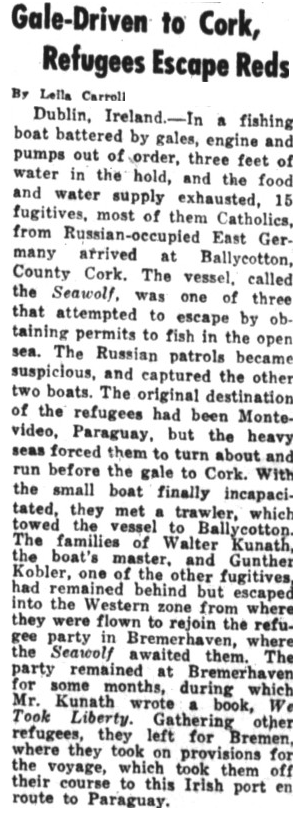
Births
Bernd Jurgen Kohler was born on 15 December 1944.Death Notices:
KOHLER, Erica  Cork COR IRL; Irish Examiner; 2000-12-4;
KOHLER, Gunther; ; Cork COR IRL; Irish Examiner; 2001-3-9


